
Why Your Employee Benefits Engagement Platform Isn't Driving Engagement
Benefits engagement platforms fail when HR measures sign-ups instead of behavior. Fixing it takes three things: real incentives tied to participation, personalization by employee need, and year-round communication — not a one-time onboarding push.
Author: Betterfly Team
Published: September 4, 2026

An employee benefits engagement platform works when it gives employees a reason to return after enrollment. Incentives, relevant benefits, year-round communication, and meaningful utilization metrics turn a one time sign up into continued participation. Without those elements, strong enrollment numbers can hide weak engagement and leave HR struggling to prove the value of its benefits investment.
Employees aren't ignoring your employee benefits engagement platform out of disinterest. They're ignoring it because it was built to be ignored: no real incentive behind it, and the metrics you use to judge it reward sign-ups instead of behavior change. That's the conversation most HR teams avoid until year-end, when they have to sit down with the CFO and justify renewing the platform while the usage report tells a different story than the enrollment report did.
You end up blaming employees for "not caring about their benefits." The platform isn't the problem. What you measure and reward is.
Why doesn’t your benefits engagement platform get used?
Most companies buy an engagement platform, run onboarding once, and treat the job as done. Onboarding alone doesn't solve burnout, stress, or absenteeism, and it's not the employee's fault for not opening an app if the company never built a reason for them to come back.
Fewer than one in three employees fully use the supplemental benefits available to them, and 13% forget they have access to them at all, according to NFP's Annual Employee Benefits Trend Report. When sign-ups are the number HR reports up, the platform is being judged on access. Access is a launch-week outcome. The benefit only pays off if participation holds through the year.
Understanding is another part of the problem. MetLife found in 2025 that only 57% of employees fully understand what their benefits cover, while 72% want benefit communications tailored to their needs. Employees who understand and are satisfied with their benefits are also 1.4 times more likely to feel engaged and 1.2 times more likely to report being productive at work.
If the metric HR reports up is "how many people signed up" instead of "how many kept participating?" or "how did utilization change?", the platform is being judged on access rather than sustained engagement, regardless of how good the underlying benefit is.
KFF's 2025 Employer Health Benefits Survey makes that distinction visible at a broader level. Among employees eligible for employer-sponsored health coverage, 76% take up the coverage offered to them. Enrollment can therefore tell you that employees entered the system. It does not tell you what happens after that.
What actually drives benefits engagement?
Turning an unjustifiable expense into an investment with a real return comes down to three things most companies overlook.
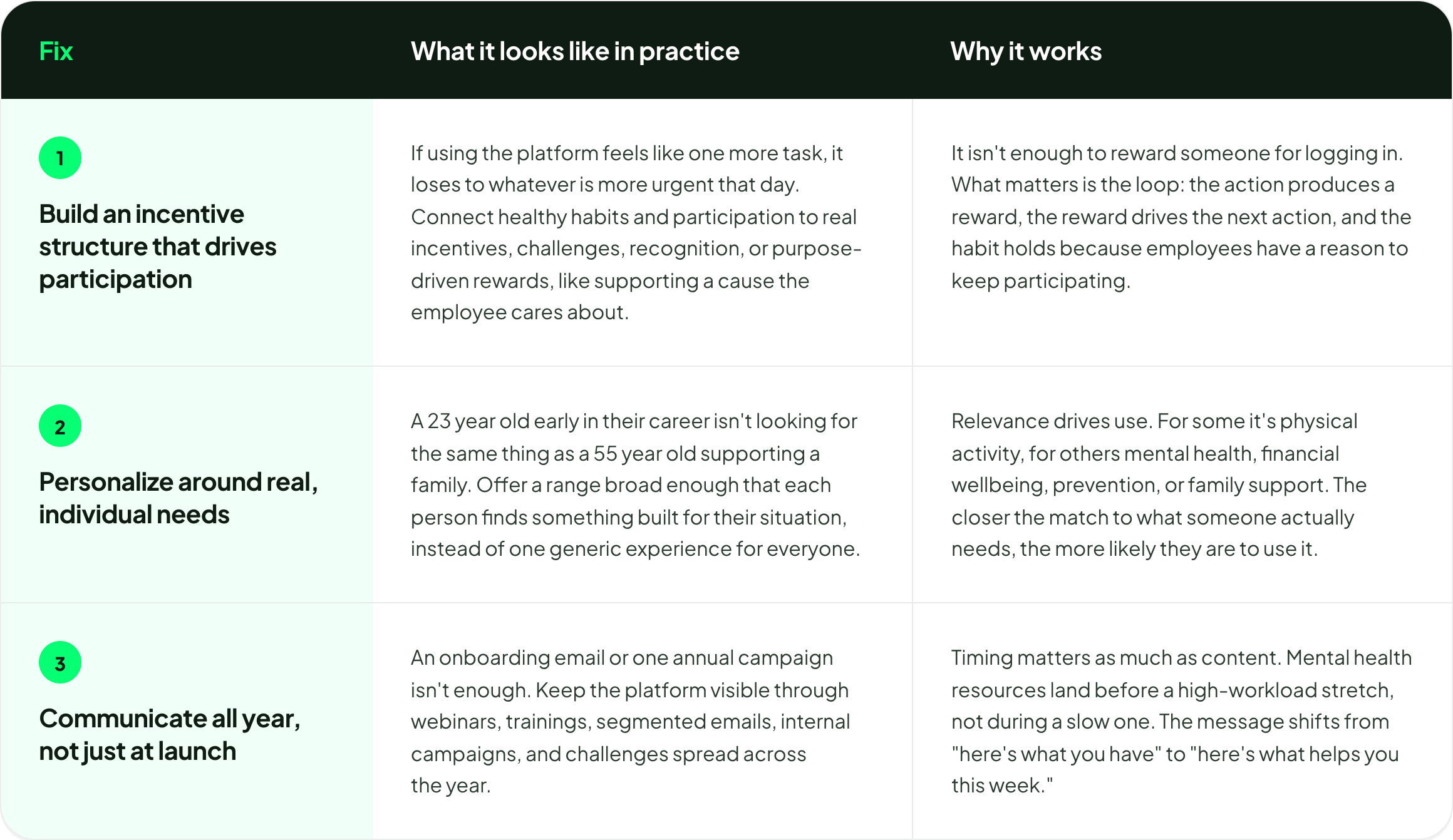
Betterfly turns benefits engagement into a loop. Employees take part in challenges that encourage healthier habits, then unlock rewards such as raffles, prize opportunities, or donations to causes they care about. A broader mix of incentives gives different employees a reason to participate based on what matters to them.
That loop stays active through continuous communication. In-app stories and the Betterfly Client Portal give employers one place to share updates, introduce new initiatives, and bring relevant benefits back into view throughout the year.
Together, incentive structure, choice, and timely communication give employees a reason to participate again. That is a better way to benefit.
Employee Benefits ROI Depends on What Happens After Enrollment
This isn't solved by switching vendors every year and hoping the next one lands differently. The first question should be whether the engagement model itself is working.
Benefits already represent a substantial investment. SHRM's 2025 Employee Benefits Survey describes benefits decisions as increasingly important as employers manage inflation, healthcare costs, workforce expectations, and retention.
The evidence does not support saying that engagement alone will automatically lower healthcare costs. Healthcare spending depends on plan design, population health, utilization, preventive care, provider prices, and other factors.
What better engagement can do is give employees more opportunities to understand and use the benefits available to them, while giving HR better visibility into utilization. NFP's 2026 report specifically identifies gaps in benefits understanding and utilization as conditions that can contribute to higher claims costs.
Get engagement right, and the renewal conversation becomes more useful: HR can show the CFO how many employees participated over time, which resources they used, and whether engagement moved alongside the outcomes the company is trying to improve.
What can HR change before the next renewal?
Restructuring how your employee benefits engagement platform rewards, personalizes, communicates, and measures participation does not necessarily require a new vendor search.
There's no reliable evidence that this can be fixed in exactly one renewal cycle; the timeline depends on the existing program, employee population, communication cadence, and the changes being introduced.
What HR can do before the next renewal is identify where participation drops, change what employees are given a reason to do next, and start measuring ongoing utilization rather than enrollment alone.
See what real engagement looks like before your next renewal conversation. Learn more about Betterfly.
Sources:
NFP — Supplemental Benefits findings (https://www.nfp.com/media/p1pi5xxr/25-cb-cb-gen-354011-usbtr.pdf)
NFP's Annual Employee Benefits Trend Report (https://www.nfp.com/human-capital/annual-benefits-trend-report/)
MetLife — Employee Benefits Trends research (https://www.metlife.com/about-us/newsroom/2025/september/new-metlife-data-finds-half-of-employees-report-feeling-disconnected-undervalued-at-work/)
KFF — 2025 Employer Health Benefits Survey (https://www.kff.org/health-costs/2025-employer-health-benefits-survey)
SHRM — 2025 Employee Benefits Survey (https://www.shrm.org/content/dam/en/shrm/topics-tools/research/employee-benefits/2025_annual_benefits_survey_executive_summary.pdf)
NFP — Supplemental Benefits findings (https://www.nfp.com/media/p1pi5xxr/25-cb-cb-gen-354011-usbtr.pdf)